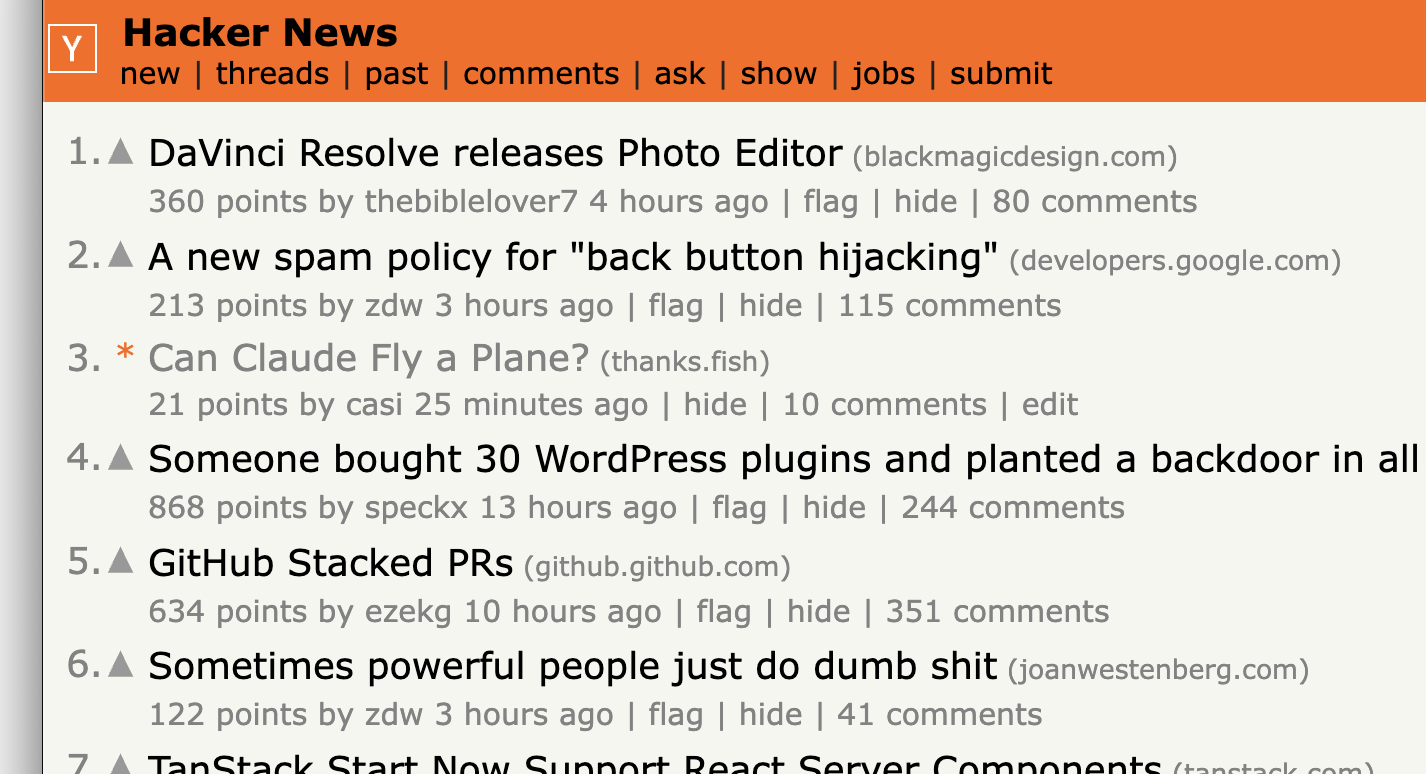
On April 14 the article Can Claude Fly a Plane? was posted to Hacker News. The submission reached the front page and sat there through the European morning. This is what that looked like from the server side over the first 24 hours, and a few things I noticed about the audience that aren't obvious from inside the HN comment thread.
the numbers
20,715 unique human readers hit the article across the 24 hours. Total requests, including the ten embedded JPGs on each page view plus a modest amount of crawler noise, came to 196,992. Bots were about 7,500 of those. Nobody saw a 5xx.
About 9,700 of those visitors arrived with news.ycombinator.com in the Referer header, which works out to 47%. The other 53% came from HN's mobile apps (which don't pass a referer), from the various HN alt-frontends and aggregators (hckrnews.com, brutalist.report, hackerweb.app, fullhn.com, hackertab.dev), from RSS readers like Inoreader and Newsblur, from one Microsoft Teams link unfurl I found amusing, and from however many people typed the URL directly or got it from a message.
the setup
One VPS, nginx, static HTML and JPGs on the filesystem. The peak hour averaged around 16 requests per second.
click-through
Of the ~20,700 readers, 246 visited the home page (about 1.2%) and 265 went on to read another article (about 1.3%). The secondary reads split across C.A.L.M. (201), Leica C 112 (111), and Control Vector Oscillation Studies (75).
That ratio is roughly what you'd expect. HN readers are task-focused. They open the linked piece, read it, and close the tab. It's also worth noting that this site isn't built to pull people deeper. There's no related-posts block, no inline cross-links between articles, no newsletter nag. The home page is a short list of titles. If you wanted to capture more of those readers you'd build it differently, and I don't, so that's fine.
comments versus readers
The gap between the readership and the commentariat was interesting too . Around 80 comments on the HN thread.. The visible reaction on HN is not representative of the reader base. A lot of the thread was "why would you do this?" read as though the piece were a serious proposal about whether Claude should pilot real aircraft (it seemed like a lot of commenters didn’t read the article, I wonder if the many people who read the article didn’t read the comments?).
The piece is a curiosity about model capability, using a silly setup as a probe:
- How does the model think ahead across multiple steps?
- How does it build and prepare its own tools when the environment is unfamiliar?
- Where does it noticeably struggle, and what does the failure look like?
- Does it have any sense of being outside of time, or does that idea not land at all?
The question is not "can Claude fly a real plane one day," and it was being missed often enough that the fault was partly in the framing on my end.
how the stats were made
A small Python script at /usr/local/bin/so-long-stats.py reads nginx's access logs (the per-site log plus the older shared one, filtered by path prefix for the window before the per-site log existed) and aggregates: unique IPs per HTML page, requests per hour, referrers, user agents, status codes, bot versus not. Cron runs it every ten minutes. It writes two files: an HTML stats dashboard at /stats/ (basic-auth protected, I'm not leaking everyone's data to the world) and a /counts.json that the home page fetches on load to show visitor counts next to each article title.
The counting is unique IPs per HTML page, which approximates "distinct readers." Bots are excluded via a user-agent regex. Only successful (200/206/304) requests to HTML paths count, which drops the massive self-referral inflation that shows up if you naively trust the top-referrers table. On a ten-image article a single page view generates about eleven requests, ten of which carry the article's own URL as their Referer. If you don't filter that out, the page appears to have a hundred thousand "visitors" when it really had ten thousand readers.