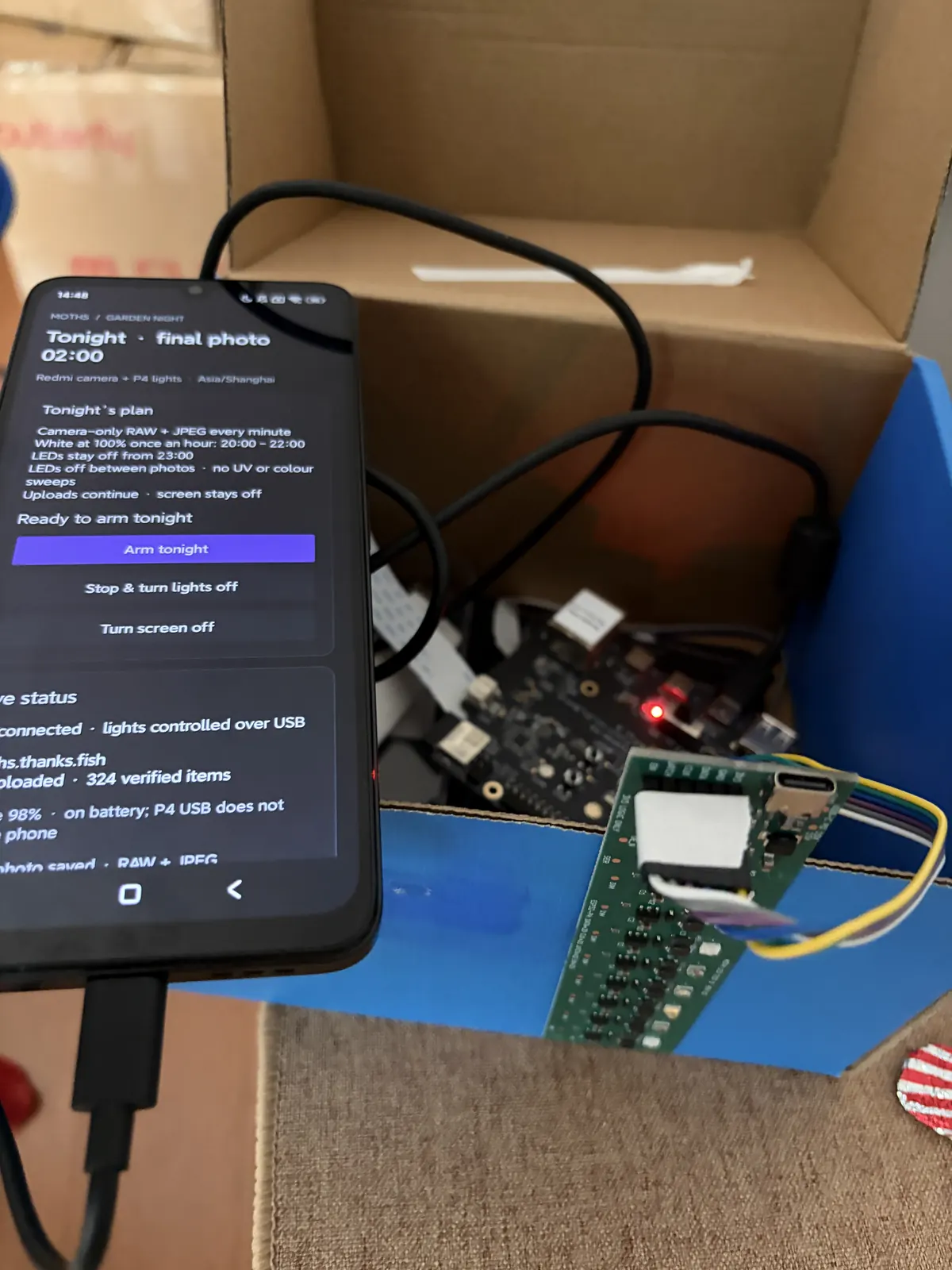
I’m working on a project that needs a high resolution camera, GPS, storage, and a microcontroller to control some lights. (More on the project soon!) I’ve been designing PCB adapters around a Raspberry Pi, an Arducam 64MP camera, and a GPS module. Every time I add another part, the bill grows.
I’m also trying an ESP32-P4 board, which will get its own post soon. But the alternative I keep coming back to is an old smartphone.
I have a Redmi 13C 5G and a Huawei Mate 30 5G. Phones like these turn up second hand on Taobao for roughly ¥300–500 (£33–56 / €40–67 / $45–75). The Redmi gives me a camera that saves 50MP JPEGs; the Mate 30 has a 40MP main camera and a telephoto lens. Both already contain GPS, storage, a clock, a battery, mobile data, and a touchscreen. Their USB-C ports give me a route to the PCB that will handle the lights and other sensors.
Here is the rough parts comparison I made while deciding what to build next:
| What I need | Used Redmi or Mate 30 | Raspberry Pi 4 approach |
|---|---|---|
| Computer | Included in phone price | Pi 4, 4GB: ¥880 / £98 / €118 / $132 |
| High resolution camera | Redmi 50MP JPEG; Mate 30 40MP | Arducam 64MP: ~¥400 / £45 / €53 / $60 |
| GPS | Included | GPS HAT: ~¥153 / £17 / €20 / $23 |
| Storage | Built in | 64GB microSD: ~¥50 / £6 / €7 / $7 |
| Core total | ¥300–500 / £33–56 / €40–67 / $45–75 | ~¥1,483 / £165 / €198 / $222 |
| Clock | Included | RTC HAT: ~¥80 / £9 / €11 / $12 |
| Battery backup | Included | UPS HAT: ~¥133 / £15 / €18 / $20, plus cells |
| Touch display | Included | 5″ touchscreen: ~¥247 / £28 / €33 / $37 |
| Mobile data | Built in, with a SIM | 4G HAT: ~¥527 / £59 / €70 / $79 |
| More fully equipped total | ¥300–500 / £33–56 / €40–67 / $45–75 | ~¥2,317 / £258 / €310 / $347, plus batteries |
These are illustrative November 2026 listings. The more fully equipped Pi total uses the cellular HAT’s GPS instead of buying the separate GPS HAT; its modem is 4G, while the phones are 5G models. Neither side includes my custom light controller PCB, a SIM or data plan, or an enclosure. The conversions use 10 November 2026 mid market rates of approximately ¥1 = £0.111531 / €0.133643 / $0.14991, rounded to whole units in the table.
The phone is already becoming more than a price exercise. I’ve unlocked and rooted the Redmi, tested its camera, and got it sleeping and waking for scheduled work. I can plug it into my computer and have Codex configure and test the pieces I need. The Huawei is harder to root, but I can still run a kiosk app on it. I’ve made a stand to photograph the same target with the Redmi and Arducam side by side; I want to see what detail each camera actually captures. A 50MP JPEG file does not, by itself, settle that question.
The open question is supply. Finding two good used phones is easy; finding a few hundred matching ones, with healthy batteries and predictable camera behaviour, would take more work. I feel increasingly confident that it’s possible.
This could be useful well beyond the current project. For digital artworks and installations, we’ve often used a Pi or a Mac mini. Imagine instead posting a client a configured phone: plug it into the display and it runs. With mobile data and remote access, I can fix something without asking a gallery for Wi-Fi privileges or an open port.
There’s something fun about taking a device made in enormous numbers, giving it a second life, and finding that most of the hardware I was about to assemble is already inside it.